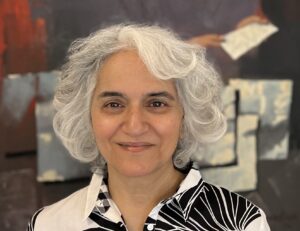
Professor Lahiri is Professor of History at Ashoka University and one of the most distinguished scholars of South Asian early history and archaeology. Her work has been instrumental in shaping contemporary understandings of South Asia’s ancient pasts and its archaeological practices.
She is the author of a wide-ranging and influential body of scholarship, including Pre-Ahom Assam (1991); The Archaeology of Indian Trade Routes (1992); Finding Forgotten Cities: How the Indus Civilization Was Discovered (2005); Marshalling the Past: Ancient India and Its Modern Histories (2012); Ashoka in Ancient India (2015); Monuments Matter: India’s Archaeological Heritage Since Independence (2017); Time Pieces–A Whistle-Stop Tour of Ancient India (2018); Archaeology and the Public Purpose: Writings on and by M.N. Deshpande (2021); and Searching for Ashoka (2023). She is also co-author of Copper and Its Alloys in Ancient India (1996), editor of The Decline and Fall of the Indus Civilization (2000), and co-editor of Ancient India: New Research (2009) and Buddhism in Asia: Revival and Reinvention (2016).
Professor Lahiri was awarded the Infosys Prize 2013 in Humanities–Archaeology, and her book Ashoka in Ancient India received the 2016 John F. Richards Prize from the American Historical Association for the best book in South Asian history.
We are honoured to welcome Professor Lahiri as our keynote speaker and look forward to welcoming her in Ghent.
Further details on her keynote lecture will follow in due course on the website of the conference: https://easaa2026.ugent.be/en.
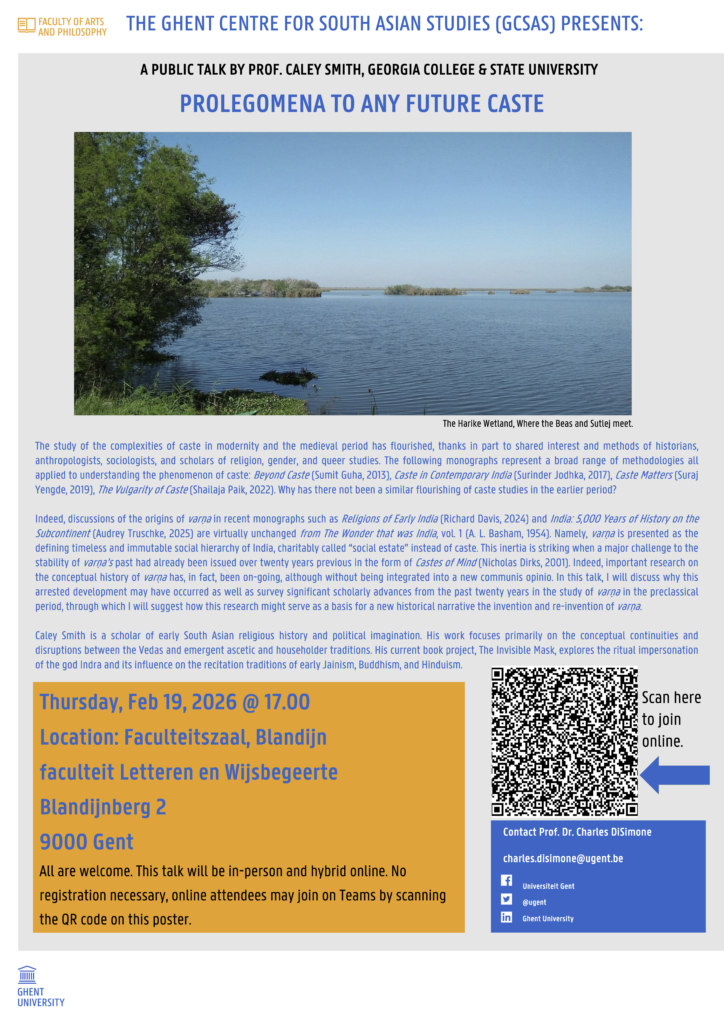
The GCSAS is delighted to announce its first guest lecture of 2026: “Prolegomena to Any Future Caste”, by Prof. Caley Smith (Georgia College & State University).
The study of the complexities of caste in modernity and the medieval period has flourished, thanks in part to shared interest and methods of historians, anthropologists, sociologists, and scholars of religion, gender, and queer studies. The following monographs represent a broad range of methodologies all applied to understanding the phenomenon of caste: Beyond Caste (Sumit Guha, 2013), Caste in Contemporary India (Surinder Jodhka, 2017), Caste Matters (Suraj Yengde, 2019), The Vulgarity of Caste (Shailaja Paik, 2022). Why has there not been a similar flourishing of caste studies in the earlier period?
Indeed, discussions of the origins of varṇa in recent monographs such as Religions of Early India (Richard Davis, 2024) and India: 5,000 Years of History on the Subcontinent (Audrey Truschke, 2025) are virtually unchanged from The Wonder that was India, vol. 1 (A. L. Basham, 1954). Namely, varṇa is presented as the defining timeless and immutable social hierarchy of India, charitably called “social estate” instead of caste. This inertia is striking when a major challenge to the stability of varṇa’s past had already been issued over twenty years previous in the form of Castes of Mind (Nicholas Dirks, 2001). Indeed, important research on the conceptual history of varṇa has, in fact, been on-going, although without being integrated into a new communis opinio. In this talk, I will discuss why this arrested development may have occurred as well as survey significant scholarly advances from the past twenty years in the study of varṇa in the preclassical period, through which I will suggest how this research might serve as a basis for a new historical narrative the invention and re-invention of varṇa.
SPEAKER BIO
Caley Smith is a scholar of early South Asian religious history and political imagination. His work focuses primarily on the conceptual continuities and disruptions between the Vedas and emergent ascetic and householder traditions. His current book project, The Invisible Mask, explores the ritual impersonation of the god Indra and its influence on the recitation traditions of early Jainism, Buddhism, and Hinduism.
For anyone curious about or interested in our new Master’s degree (hybrid), please feel welcome to one of our two online information sessions. During these sessions, we will provide further details about the program, admission and funding opportunities. There will be time for questions and answers.
Both sessions are identical, but accommodate prospective students in different time zones. Click the session below you wish to attend to register and receive the Teams link:
Session 1: January 15th, 2026 at 18:00 CET, 22:30 IST, 12 noon EST, 9:00 PST
Session 2: January 16th, 2026 at 10:00 CET, 14:30 IST, 4:00 EST, 1:00 PST
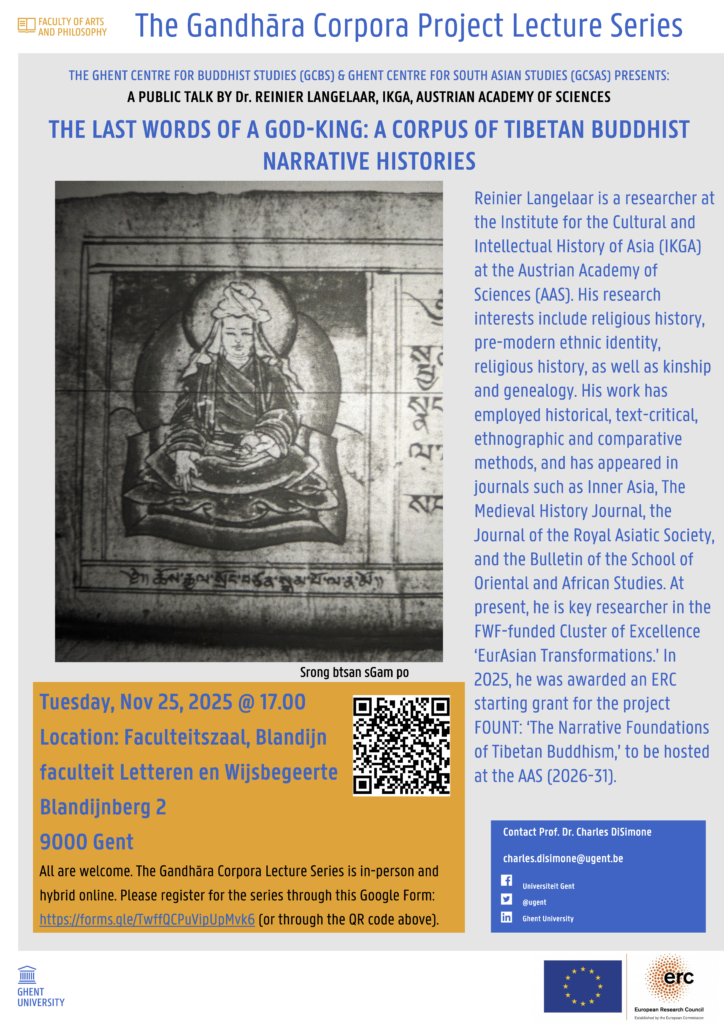
The third lecture of the Gandhāra Corpora Lecture Series will have Dr. Reinier Langelaar (Institute for the Cultural and Intellectual History of Asia, Austrian Academy of Sciences) joining us as the guest speaker, with a talk titled “The Last Words of a God-King: A Corpus of Tibetan Buddhist Narrative Histories”.
All are welcome. The Gandhāra Corpora Lecture Series is in-person and hybrid online.
Time & venue
When: Tuesday 25 November 2025, at 17:00 (5 pm CET)
Where: Faculteitszaal, Faculteit Letteren en Wijsbegeerte, Blandijnberg 2, 9000 Gent
This lecture will present a highly influential corpus of Buddhist historiographies, composed and expanded upon from perhaps the 12th c. CE onward. These works are attributed, as so-called ‘treasure texts,’ to the 7th-c. emperor Songtsen ‘the Profound’ (Tib. srong-btsan sgam-po), himself claimed to be an emanation of the bodhisattva Avalokiteśvara. This corpus constitutes a literary meeting ground for a series of pivotal developments in the realm of Tibetan Buddhist religion, political philosophy, and perceptions of Tibet and its people at large. Weaving compelling tales of Tibetan society’s history, it played a central role in formulating and propagating understandings of Tibet as a Buddhist realm under Avalokiteśvara’s special protection. Though eminently focused on Tibet, these works are also embedded in interregional webs of cultural exchange, potentially drawing inspiration from Indian sūtra literature, Newari Buddhism, Chinese and Khotanese notions of bodhisattva kingship, and more. This talk will introduce this body of works, discuss the particular text-historical and methodological challenges it presents, and show what we may hope to gain from its study.
Bio
Reinier Langelaar is a researcher at the Institute for the Cultural and Intellectual History of Asia (IKGA) at the Austrian Academy of Sciences (AAS). His research interests include religious history, pre-modern ethnic identity, religious history, as well as kinship and genealogy. His work has employed historical, text-critical, ethnographic and comparative methods, and has appeared in journals such as Inner Asia, The Medieval History Journal, the Journal of the Royal Asiatic Society, and the Bulletin of the School of Oriental and African Studies. At present, he is key researcher in the FWF-funded Cluster of Excellence ‘EurAsian Transformations.’ In 2025, he was awarded an ERC starting grant for the project FOUNT: ‘The Narrative Foundations of Tibetan Buddhism,’ to be hosted at the AAS (2026-31).
The Ghent Centre for South Asian Studies (GCSAS) and the Ghent Centre for Buddhist Studies (GCBS) are pleased to host the second talk in the Fall 2025 iteration of the Gandhāra Corpora Lecture Series on 20 November 2025:
Title
Sustaining Digital Heritage Beyond Funding: Building on the DiGA Project
Speakers
Prof. Jessie Pons (CERES, Ruhr-Universität Bochum)
&co.:
Serena Autiero (Thammasat University, Bangkok), Frederik Elwert (CERES, Ruhr-Universität Bochum), Cristiano Moscatelli (Independent Researcher), Abdul Samad (KPDOAM)
Time & venue
Thursday, 20 November 2025 at 17:00 (5 pm CET)
in person: Faculteitszaal, Faculteit Letteren en Wijsbegeerte, Blandijnberg 2, 9000 Gent
remotely: please register through this Google Form
Abstract
From 2021 to 2024, the DiGA project (“Digitization of Gandharan Artefacts: A project for the preservation and study of the Buddhist art from Pakistan”) documented a collection of approximately 1,500 Gandharan sculptures preserved at the Dir Museum in Chakdara, Khyber-Pakhtunkhwa Province (KP), Pakistan. These sculptures originated from a dozen archaeological sites in the Shah-kot/Talash zone (around present-day Chakdara), excavated by the Directorate of Archaeology and Museums, KP, and the Department of Archaeology at Peshawar University in the 1960s and 1970s. As one of the few Gandharan sculptural corpora with established archaeological provenance, this collection provides a solid foundation for reassessing key questions in Gandhara studies, particularly regarding the history of Buddhism on the right bank of Swat River. The database of the collection is now available on the heidICON platform, ready to lend itself to exciting research avenues.
With the project officially coming to an end, however, new questions emerge: how can such a project remain active and relevant beyond its institutional and financial framework? How can its data continue to be curated, enriched, and mobilized for research and public engagement once the funding period ends? This presentation will report some of the project’s activities in the post-funding phase. It will share results from recent research based on the DiGA corpus, sketch the outline of a research program building on the project’s legacy, and discuss ongoing initiatives with KPDOAM on community engagement. Ultimately, this talk invites reflection on the broader question of how digital heritage projects can evolve sustainably once their formal lifecycle has ended.
Bios
Jessie Pons (CERES, Ruhr-Universität Bochum):
Jessie Pons is Professor for the History of South Asian Religions at the Center for Religions Studies at Ruhr-Universität Bochum. Trained as an art historian, Jessie Pons explores how religion and art intersect and how material objects shape religious communication, lived experiences, and scholarly interpretation.
Serena Autiero (Thammasat University, Bangkok):
Serena Autiero is an archaeologist and material culture historian. She is currently a researcher at Thammasat University. Her research interests include cultural exchange in Afroeurasia in pre-modern times, globalization studies, and a special focus on the Indian Ocean World. She authored several publications in international journals and co-edited Globalization and Transculturality from Antiquity to the Pre-Modern World for Routledge.
Frederik Elwert (CERES, Ruhr-Universität Bochum):
Frederik Elwert is associate professor at the Center for Religious Studies, Ruhr University Bochum. His background is in religious studies and sociology. He has applied digital humanities methodologies in different areas of the study of religions.
Cristiano Moscatelli (Independent Researcher):
Cristiano Moscatelli specialises in Gandharan studies. His research interests focus on Buddhist visual and material culture and on the interactions between Buddhism and local religious systems in the ancient north-western Indian subcontinent. In addition to his work with DiGA, he was a research fellow with the eartHeritage project – A cultural rescue initiative for earthen heritage, investigating clay and stucco Buddhist sculpture from Central Asia through the development of a digital database for the collection, preservation, and dissemination of archaeological data.
Abdul Samad (KPDOAM):
Abdul Samad is Secretary of Tourism, Culture, Archaeology and Museums, Government of Khyber-Pakhtunkhwa (KP) Pakistan as well as Director General of Archaeology & Museums KP. He has two decades of experience in South Asian archaeology, history, and culture, extensively exploring Pakistan’s rich heritage, focusing particularly on the Gandhara and Kalash civilizations. As the Director of the Directorate of Archaeology and Museums in Khyber Pakhtunkhwa, he has led numerous initiatives to preserve and promote the cultural legacy of KP through national and international Projects.
All are welcome. The Gandhāra Corpora Lecture Series is in-person and hybrid online (Google Form for online participation: https://forms.gle/TwffQCPuVipUpMvk6).
Filmmaker and exhibition curator Harsha Vinay will be present to introduce and discuss his work. The programme features two of his documentaries, exploring the ritual and material worlds of Jainism and Hinduism—millennia-old religions that continue to thrive globally, including in Belgium’s vibrant Indian community of Antwerp.
Both films merge ethnography and aesthetics, transforming museum projects into cinematic explorations of how religion is lived, performed, and materialised.
After the screening, an open discussion with the filmmaker moderated by researchers from GCSAS and ViDi will delve into heritage documentation, and the role of film in representing living traditions.
TIME & VENUE
When: Thursday 13 November 2025, from 17:00 to 19:00 (5 pm – 7 pm CET)
Where: S.M.003, De Meerminne (Stadscampus), Faculty of Social Sciences – University of Antwerp, Sint-Jacobstraat 2, 2000 Antwerp
Short Films for Being Jain. Art and Culture of an Indian Religion
2022
Originally made for the Museum Rietberg’s exhibition Being Jain. Art and Culture of an Indian Religion (2022-2023), these short films explore key aspects of ritual and material culture within Jainism — including pilgrimage, asceticism, manuscript traditions, ritual death, and everyday lay practices — and have since been screened across the USA, Europe, and India.
Mirrors of Malabar
2019
Produced for the Museum Rietberg’s exhibition THE MIRROR – Our Reflected Self(2019) and subsequently screened internationally, Mirrors of Malabar document the making and ritual use of mirrors in worship and possession practices of coastal Kerala (southwestern India).
Guest speaker’s bio
Harsha Vinay is the Founder Director of Green Barbet Ltd, India, with over ten years’ experience in curating exhibitions for international museums, cultural programming, administering an artist residency, production of research publications and documentary films.
Harsha holds an MA from the School of Arts & Aesthetics, Jawaharlal Nehru University, New Delhi, and a BFA in Painting from College of Fine Art, Bangalore. From 2013 to 2015 he worked at the National Gallery of Modern Art, Bangalore, as Assistant Curator in-charge of exhibitions, programmes and outreach. Prior to this he was the ‘Specialist Writer & Subject Expert’ on the curatorial team of the ICCR sponsored exhibition ‘The Body in Indian Art andThought’, Bruxelles 2013. Here, Harsha was entrusted with research and collation of documentary films from the archives of the IGNCA and Sangeet Natak Akademi on the living traditions of India.
In 2016, Harsha Vinay moved to Varanasi as Director of the Alice Boner Institute, a residency space for academic and artistic research founded to keep alive the legacy of Swiss artist and scholar Padma Bhushan Dr. Alice Boner. Here he organised artist residencies, exhibitions, symposiums, and cultural events with a range of international institutions.
In 2018, Harsha started his own cultural enterprise in Bangalore – ‘Green Barbet: a company for art and culture in South Asia‘, which provides consultancy and advisory services for museums and cultural organisations within and outside India. Under the aegis of this company, Harsha Vinay has co-curated and collaborated on large exhibitions at Museum Rietberg, including ‘Alice Boner – Artist and Scholar’, 2015-18, ‘Mirror – The Reflected Self’, 2018-19, ‘Being Jain: Art and Culture of an Indian Religion’, 2022-23 and more recently ‘Ragamala – Pictures for all the Senses‘, 2024-25.
Harsha has organised numerous international programmes such as Dialogues on Alice Boner Symposium, January 2018, large public events and workshops in Zurich and Varanasi for a diverse audience. Harsha is co-editor of the publication series Alice Boner Dialogues, initiated in 2020. His experience includes facilitating exchange workshops for traditional artisans for the Crafts Council of India, Chennai and documenting craft traditions of Varanasi through short demonstrational videos by artisans. His interests also extend to art education, capacity building and integrating communities with museum spaces.
Harsha lives and works between Varanasi and Bangalore.
Developed in continuity with the Internationalisation@Home session at Ghent University on 12/11/2025, this event is organised in collaboration with Museum Rietberg (Zurich), Green Barbet Ltd (India), and the Visual & Digital Cultures Research Center, University of Antwerp. Funded by the Department of Languages and Cultures, Faculty of Arts and Philosophy, Ghent University, and FWO (Odysseus Type II grant: “The Mosques of Kerala. Artistic Vocabularies in the Identity-Building of Muslim Communities”).
On 13 November 2025, the Ghent Centre for South Asian Studies (GCSAS) and the Ghent Centre for Buddhist Studies (GCBS) are pleased to welcome Dr Keiki Nakayama (University of Leipzig) for a lecture entitled Resituating the Yogācārabhūmi Corpus: Potential Gandhāran Links and Sūtra-Grounded Practice.
The Yogācāra school, together with the Madhyamaka, is well known as one of the two major streams of Indian Mahāyāna Buddhism. Yet its foundational text, the Yogācārabhūmi, contains numerous passages that follow the modes of description characteristic of the Śrāvakayāna tradition. The author(s) of this work are thought to have belonged to a lineage that transmitted the Mūlasarvāstivāda Vinaya. Thus, while the Yogācārins were moving away from the Sarvāstivāda mainstream, they also inherited many of its scholastic and disciplinary elements.
The first part of this presentation reconsiders the position of the Yogācārabhūmi—and hence early Yogācāra—in relation to the Sarvāstivāda tradition. The Yogācāra school appears to have shared doctrinal affinities with internal Sarvāstivādin groups such as the Dārṣṭāntikas and Vibhajyavādins mentioned in the Mahāvibhāṣā. Focusing on the Gandhāra region, I examine evidence suggesting that the “Western Masters” (Pāścāttyas), associated with Gandhāra, held positions that coincide with those of the Yogācārabhūmi, thereby indicating possible intersections between Yogācāra and Gandhāran Buddhism.
Later but related materials include numerous Mūlasarvāstivāda Vinaya manuscripts discovered in Gilgit, part of Greater Gandhāra. These texts notably embed a variety of sūtras. If the sūtras employed in the Yogācārabhūmi correspond to those appeared in the Mūlasarvāstivāda Vinaya, this strengthens the view that the Yogācārabhūmi originated from a tradition closely linked to the transmitters of the Mūlasarvāstivāda Vinaya. The recently studied Dīrghāgama (Long Discourses) manuscripts from Gilgit also deserve attention.
The latter half of the talk examines how the Yogācārabhūmi actively incorporates and reinterprets sūtras within its structure of practice. Focusing on the Śrāvakabhūmi, the earliest stratum of the text, I argue that the Yogācāra school, though renowned as meditative practitioners, grounded their practice in close engagement with the words of the Buddha.
Bio
Keiki Nakayama is a guest researcher and lecturer at the Institute for South and Central Asian Studies, Leipzig University. Having recently fulfilled the requirements for a PhD at Kyoto University, he is currently conducting research on the interpretation of canonical scriptures within the Yogācāra school, supported since 2023 by the Bukkyō Dendō Kyōkai (BDK). His publications include a co-authored article with Jens-Uwe Hartmann, “One Hundred and Eight Distinctions of Craving: The Tṛṣṇā-sūtra of the Saṃyuktāgama,” in Mind, Text, and Reality in Buddhist Studies: Engaging the Scholarship of Rupert Gethin (Bloomsbury, 2025), and a co-authored monograph with Izumi Miyazaki et al., The Seventy-five Elements (Dharma) in the Madhyamakapañca-skandhaka, in Bauddhakośa: A Treasury of Buddhist Terms and Illustrative Sentences, Volume VIII (The International Institute for Buddhist Studies, 2022).
ARTS, RELIGIONS AND LIVING TRADITIONS OF INDIA: FILM SCREENINGS AND CONVERSATION WITH HARSHA VINAY
Kunsthal Gent opens its doors to the Ghent Centre for South Asian Studies (GCSAS) and to filmmaker and exhibition curator Harsha Vinay for an evening exploring the vibrant artistic, cultural, and religious landscapes of South Asia.
Through three short documentaries, Vinay guides us on a cinematic journey across India, portraying living traditions that shape communities and artistic expressions.
The screenings will be followed by an open discussion to delve into how heritage and religion intertwine in India, and how multimedia documentation can preserve and reinterpret fading cultural traditions within and beyond South Asia.
Time & venue
When: Wednesday 12 November 2025, from 20:00 to 22:00 (8 pm – 10 pm CET)
Where: Kunsthal Gent, Lange Steenstraat 14, 9000 Gent
Produced for the Museum Rietberg’s exhibition THE MIRROR – Our Reflected Self(2019) and subsequently screened internationally, Mirrors of Malabar document the making and ritual use of mirrors in worship and possession practices of coastal Kerala (southwestern India).
Short Films for Being Jain. Art and Culture of an Indian Religion 2022
Originally made for the Museum Rietberg’s exhibition Being Jain. Art and Culture of an Indian Religion (2022-2023), these short films explore key aspects of ritual and material culture within Jainism — including pilgrimage, asceticism, manuscript traditions, ritual death, and everyday lay practices — and have since been screened across the USA, Europe, and India.
Portrait of a Cloud.Mindscape of an Indian miniature artist 2025
This film documents the making of the contemporary Ragamala painting ‘Raga Megha’, highlighting the intricacies and nuances of this refined art form. Interwoven with the creative process is the story of Manish Soni, an artist from Rajasthan who began painting miniatures at the age of 21. The film was produced for the Museum Rietberg’s exhibition Ragamala. Pictures for all the senses (2025), which recently concluded.
Guest speaker’s bio
Harsha Vinay is the Founder Director of Green Barbet Ltd, India, with over ten years’ experience in curating exhibitions for international museums, cultural programming, administering an artist residency, production of research publications and documentary films.
Harsha holds an MA from the School of Arts & Aesthetics, Jawaharlal Nehru University, New Delhi, and a BFA in Painting from College of Fine Art, Bangalore. From 2013 to 2015 he worked at the National Gallery of Modern Art, Bangalore, as Assistant Curator in-charge of exhibitions, programmes and outreach. Prior to this he was the ‘Specialist Writer & Subject Expert’ on the curatorial team of the ICCR sponsored exhibition ‘The Body in Indian Art andThought’, Bruxelles 2013. Here, Harsha was entrusted with research and collation of documentary films from the archives of the IGNCA and Sangeet Natak Akademi on the living traditions of India.
In 2016, Harsha Vinay moved to Varanasi as Director of the Alice Boner Institute, a residency space for academic and artistic research founded to keep alive the legacy of Swiss artist and scholar Padma Bhushan Dr. Alice Boner. Here he organised artist residencies, exhibitions, symposiums, and cultural events with a range of international institutions.
In 2018, Harsha started his own cultural enterprise in Bangalore – ‘Green Barbet: a company for art and culture in South Asia‘, which provides consultancy and advisory services for museums and cultural organisations within and outside India. Under the aegis of this company, Harsha Vinay has co-curated and collaborated on large exhibitions at Museum Rietberg, including ‘Alice Boner – Artist and Scholar’, 2015-18, ‘Mirror – The Reflected Self’, 2018-19, ‘Being Jain: Art and Culture of an Indian Religion’, 2022-23 and more recently ‘Ragamala – Pictures for all the Senses‘, 2024-25.
Harsha has organised numerous international programmes such as Dialogues on Alice Boner Symposium, January 2018, large public events and workshops in Zurich and Varanasi for a diverse audience. Harsha is co-editor of the publication series Alice Boner Dialogues, initiated in 2020. His experience includes facilitating exchange workshops for traditional artisans for the Crafts Council of India, Chennai and documenting craft traditions of Varanasi through short demonstrational videos by artisans. His interests also extend to art education, capacity building and integrating communities with museum spaces.
Harsha lives and works between Varanasi and Bangalore.
Developed in continuity with the Internationalisation@Home session at Ghent University on 12/11/2025, this event is organised in collaboration with Museum Rietberg (Zurich), Green Barbet Ltd (India), GBF Foundation for Cooperative Research on South Asian Art and Artists, and Kunsthal Gent. Funded by the Department of Languages and Cultures, Faculty of Arts and Philosophy, Ghent University, and FWO (Odysseus Type II grant: “The Mosques of Kerala. Artistic Vocabularies in the Identity-Building of Muslim Communities”).
The Ghent Centre for South Asian Studies (GCSAS) is proud to announce a special lecture-event as part of the Internationalisation@Home programmeof the Faculty of Arts and Philosophy:
FROM MUSEUM TO FILM AND BACK: A JOURNEY THROUGH JAINISM, ITS ART AND LIVING TRADITIONS – Film screening and discussion with curator-filmmaker Harsha Vinay
This event celebrates Jain studies at Ghent University with a screening of five short films by Harsha Vinay exploring key aspects of ritual and material culture within Jainism — pilgrimage, asceticism, manuscript traditions, ritual death, and everyday lay practices.
Jainism is a millennia-old religion that originated in India and is now practiced worldwide, with Belgium home to the largest Jain community in continental Europe.
The screening and discussion will take place during the class hour of the course Art and Archaeology of South Asia and are open to everyone — no prior registration required.
When: Wednesday 12 November 2025, from 12:30 to 14:30 (12:30-2:30 pm CET)
Harsha Vinay is the Founder Director of Green Barbet Ltd, India, with over ten years’ experience in curating exhibitions for international museums, cultural programming, administering an artist residency, production of research publications and documentary films.
Harsha holds an MA from the School of Arts & Aesthetics, Jawaharlal Nehru University, New Delhi, and a BFA in Painting from College of Fine Art, Bangalore. From 2013 to 2015 he worked at the National Gallery of Modern Art, Bangalore, as Assistant Curator in-charge of exhibitions, programmes and outreach. Prior to this he was the ‘Specialist Writer & Subject Expert’ on the curatorial team of the ICCR sponsored exhibition ‘The Body in Indian Art andThought’, Bruxelles 2013. Here, Harsha was entrusted with research and collation of documentary films from the archives of the IGNCA and Sangeet Natak Akademi on the living traditions of India.
In 2016, Harsha Vinay moved to Varanasi as Director of the Alice Boner Institute, a residency space for academic and artistic research founded to keep alive the legacy of Swiss artist and scholar Padma Bhushan Dr. Alice Boner. Here he organised artist residencies, exhibitions, symposiums, and cultural events with a range of international institutions.
In 2018, Harsha started his own cultural enterprise in Bangalore – ‘Green Barbet: a company for art and culture in South Asia‘, which provides consultancy and advisory services for museums and cultural organisations within and outside India. Under the aegis of this company, Harsha Vinay has co-curated and collaborated on large exhibitions at Museum Rietberg, including ‘Alice Boner – Artist and Scholar’, 2015-18, ‘Mirror – The Reflected Self’, 2018-19, ‘Being Jain: Art and Culture of an Indian Religion’, 2022-23 and more recently ‘Ragamala – Pictures for all the Senses‘, 2024-25.
Harsha has organised numerous international programmes such as Dialogues on Alice Boner Symposium, January 2018, large public events and workshops in Zurich and Varanasi for a diverse audience. Harsha is co-editor of the publication series Alice Boner Dialogues, initiated in 2020. His experience includes facilitating exchange workshops for traditional artisans for the Crafts Council of India, Chennai and documenting craft traditions of Varanasi through short demonstrational videos by artisans. His interests also extend to art education, capacity building and integrating communities with museum spaces.
Harsha lives and works between Varanasi and Bangalore.
This event is funded by the Department of Languages and Cultures, Faculty of Arts and Philosophy of Ghent University, and organised in collaboration with the Museum Rietberg, Zurich, and Green Barbet Ltd, India.
Join us for an engaging lecture by Prof. Anne Murphy (Department of History, University of British Columbia), who will explore the evolving figure of the faqīr in early modern South Asian literature and religious thought.
Through a comparative reading of two versions of the legendary Punjabi love story Hīr and Rāṅjhā, Prof. Murphy examines how the faqīr was understood in relation to magic, technical mastery, and bhakti (devotion). The talk will delve into the historical and literary significance of these texts and their portrayal of spiritual figures in the complex religious landscape of early modern Punjab.
Details:
Date: October 29
Time: 16:00
Location: Faculty Board Room, Blandijn, Campus Boekentoren and online (click to register)
Hosted by: Ghent Center for South Asia Studies
This event is open to all and promises to offer rich insights into South Asian history, literature, and religion.